
*
Homepage


01/18 (Sun)

Closed Today

*
United in Art— Artist Groups and Their Network of Activities during the Japanese Colonial Period

Publication date: 29 Jun 2021
Author: Jao Tsu-hsien |Staff member of the Archives of Institute of Taiwan History

A digital collection of archival documents has been in development over the recent years under the auspices of the Archives of Institute of Taiwan History, Academia Sinica. It includes the profiles of such artists from the preceding generations as Chen Cheng-Po, Yen Hsuei-Long, Chen Chih-Chi, Pu Tian-Sheng, Liu Chi-Hsiang, Kuo Hsueh-Hu in addition to papers of the nature of cultural patronage from Yang Zhao-Jia as well as private collections of works of calligraphy and painting and other historical materials. This article focuses on the activities of important artist groups that Taiwanese painters helped to create during the first half of the 20th century. Through selected private manuscripts, letters and documents, images, newspapers and magazines housed in the Archives, the exploration of interactions between various parties in the history of modern art - including individual artists, the painting groups and their patrons - reveals how the arts and society developing in parallel and prospering in unison!

*
IV. Lin’s Footsteps in France

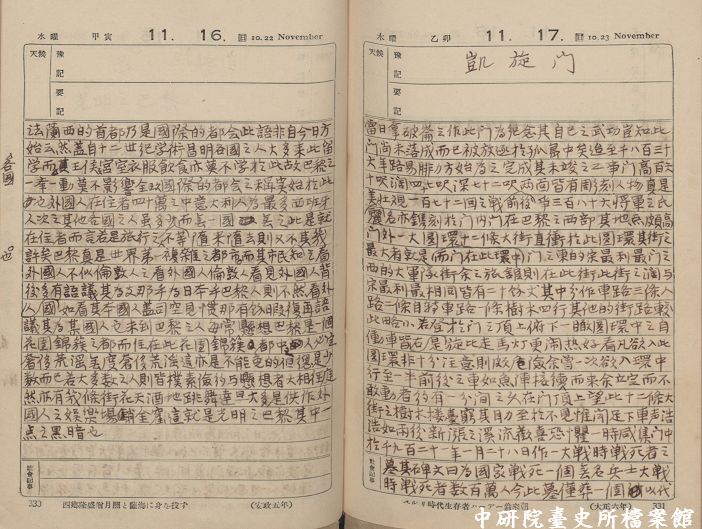
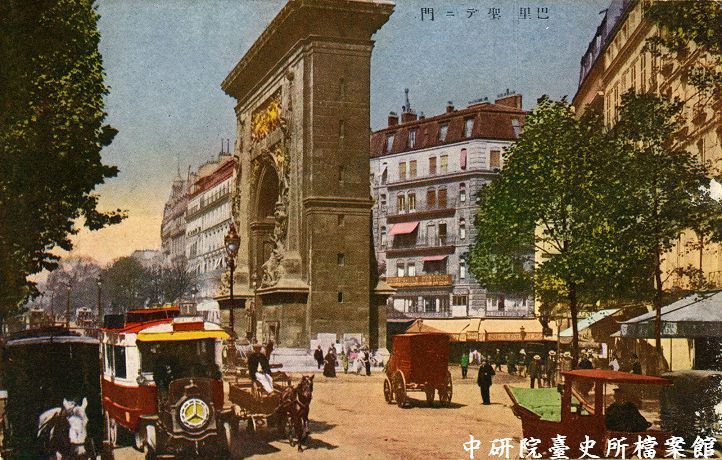
On November 14, Lin and his sons arrived at the City of Light, which referred to Paris. In his diary, Lin Xian-tang thought Paris had both lightness and darkness, but there was more good than bad. In his diary, Lin said the streets in Paris were beautiful and ordered. Also, the historical sites in Paris could remind people of history. In addition, Paris was an international city where many visitors visited. As a result, it was common for citizens in Paris to meet foreigners. In other words, Parisians did not regard foreigners as outsiders, which was totally different from people in other countries. In fact, people who had not visited Paris usually imagined Paris as a beautiful city. In their mind, the life in Paris must be luxurious and dissolute. In fact, most of the Parisians had a plain life. Even though there were some streets with many places of entertainment, the places were actually mainly for foreigners. This is so called a little darkness in light. (See Figure 6 & 7)
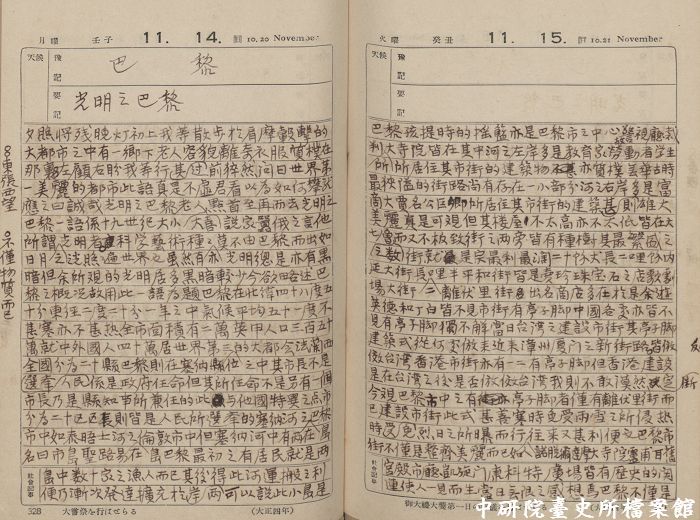
Figure 6: The Diary of Mr. Guan-yuan on November 14, 1927.
(Source: The Diary of Mr. Guan-yuan, the digital archives of the Archives of Institution of Taiwan History)
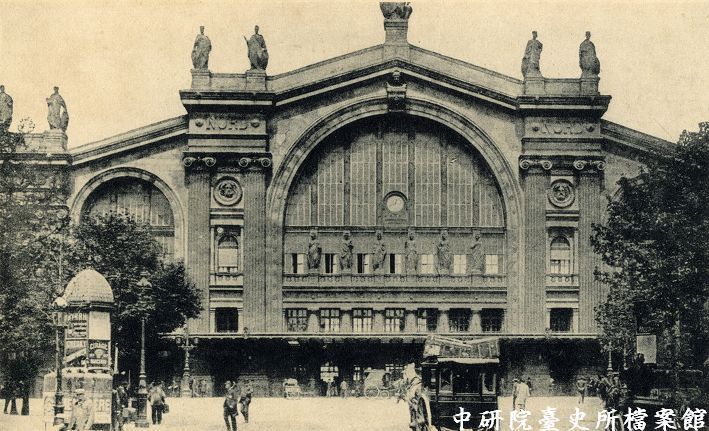
Figure 7: The Paris Station and Porte Saint-Denis.
(Source: Michael H.Finegan Collections, the digital archives of the Archives of Institution of Taiwan History)
11F., South Wing, Building for Humanities and Social Sciences, 128, Sec. 2, Academia Rd., Nangang Dist., Taipei City 11529,
Taiwan Tel: +886-2-2652-5181 Fax: +886-2-2652-5184 【Contact us
Copyright © 2010 Institute of Taiwan History, Academia Sinica. All Rights Reserved