|
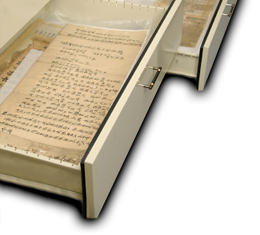
The "Qiu Hui collection" (秋惠文庫) primarily consists of ancient documents from the Qing Dynasty and Japanese Colonial Period, spanning from the 31st year of the Qianlong Emperor (1766) to the 36th year of the Meiji Era (1903). It includes official correspondence documents between the Anli (岸裡社) and Maoluo (貓羅社) tribes and the authorities. There are also land lease agreements from Jiaoxi and Toucheng in Yilan, involving transactions with communities such as the Chiwulan (淇武蘭 社) and Qiwulao (奇武荖社) tribes.
Additionally, the collection features Sinkang Manuscripts during the Qianlong period, educational records from the Jiaqing period, and maps of Taipei City Wall during Qing Dynasty. Documents related to the construction of Yunlin County in and land reclamation in central Taiwan are also included. These encompass cultural records like Chen Shile's "Eight Views of Yunlin" and resume-related documents for Chen Shangda, alongside maps of Nantou and Yunlin County.
The catalog of these archival documents is now accessible through the "Taiwan Archival Information System," where visitors are welcome to inquire and access digital images in person at the archives.

Figure 1: "Deed of Sale for Land Reclamation Contract" in November 1864
This document records the sale of irrigated fields by Lin He-fa, a Han Chinese, to the Qiwulan tribe. The deed is marked with handprints and seals, illustrating the land transactions between Han Chinese and the local aboriginal community in the development process of the Yilan region.
Source: "Deed of Sale for Land Reclamation Contract by Lin He-fa Purchasing Fields in November 1864," "Qiu Hui collection" (T1092), Digital Collection of Archives of Institute of Taiwan History, Academia Sinica.

Figure 2: "Deed of Sale for Land Contract" in March 1782
This document is written bilingually in Chinese characters and Romanized Pinyin. It records the sale of fields located within the Banziqiao Pond by members of the Madou tribe (蔴荳社), including the woman Tuo Zaidat in Nashi, to Xie Zongyang.
Source: "Deed of Sale for Land Contract by Xie Zongyang Purchasing and Selling Fields from Tuo Zaidat and Others in March 1782," "Qiu Hui collection" (T1092), Digital Collection of Archives of Institute of Taiwan History, Academia Sinica.

Figure 3: The map of Lin Yipu, the old county town of Yunlin
The map of Linyipu (林圯埔), the old county town of Yunlin (now within the jurisdiction of Zhushan Township, Nantou County), is centered around this area, which was established by Chen Shile (陳世烈), the first Yunlin County Magistrate, under orders to construct the county seat. The map depicts the surrounding mountains, hydrology, villages, boundaries, and the locations of aboriginal communities.
Source: "Map and Public Documents," "Qiu Hui collection" (T1092), Digital Collection of Archives of Institute of Taiwan History, Academia Sinica.
|