


| 2017-09-04 |
|
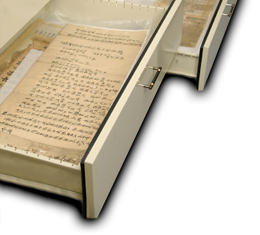
Tai-yi-hou Papers of Nagasaki were the documents created and preserved by the Chen family from Kinmen. Chen family had a long history in running business in Nagasaki and these documents recorded their trading business and social activities that they participated from the 1880s to the 1940s when Chen Rui-chun (1840-1908), Chen Shi-wang (1869-1940) and Chen Jin-zhong (1890-1974) were in charge. The Papers contain a huge amount of business letters and historical materials related to Chen’s enterprise operation, family activities, and overseas Chinese affairs. It is definitely the first-hand historical source to research the trade development in modern East Asia and overseas Chinese affairs. The Institute of Taiwan History and Mr. Chen Dong-hua, the offspring of the Chen family, had signed the agreement to digitalize the Tai-yi-hou Papers in 2012. We acquired the archives five times from April, 2014 to June, 2017 and transported more than 50,000 original items from Japan to Taiwan, including correspondences, account books, code books, receipts, contracts, publications, seals, relics, etc. Based on types and purposes, the Tai-yi-hou Papers are categorized into commercial letters, operational documents, family collections, and the documents of Fujian Guildhall and overseas Chinese affairs. Since the quantity of Tai-yi-hou Papers is enormous and therefore the compiling procedure is time consuming, the archives will open in stages. Now, the series of Taiwan Commercial Letters is open online. There are approximately 17,000 commercial letters and over 50,000 digital images. All letters are first organized based on which business stores they were from and then classified on the basis of where the business stores located. The commercial letters are categorized on the basis of different business stores so that readers can easily access letters from each business store. In addition, envelopes, paper, and stamp marks that different business stores used are helpful for readers to understand the history and the operating situation of these different stores as well as their business interactions with Tai-yi-hou. Moreover, “Biography and History” and “Related Material” contain the information about the historical development and the connections between different stores. These letters show the development of different regions and record important historical events so as to present the various features of commercial activities in Taiwan in the 20th century. Taiwan Commercial Letters, the second series of Tai-yi-hou Papers of Nagasaki, has released now. We welcome the public to access Taiwan Archival Information System and retrieve the materials. 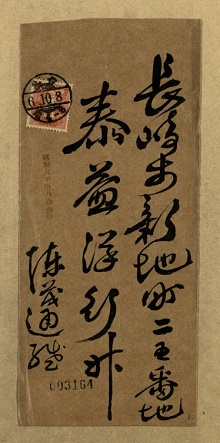 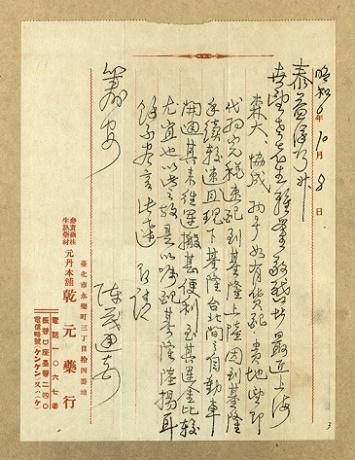 Figure:The letter sent from Taipei Qian-yuan Pharmacy on October 8, 1931. |