

| 2012-10-02 |
|
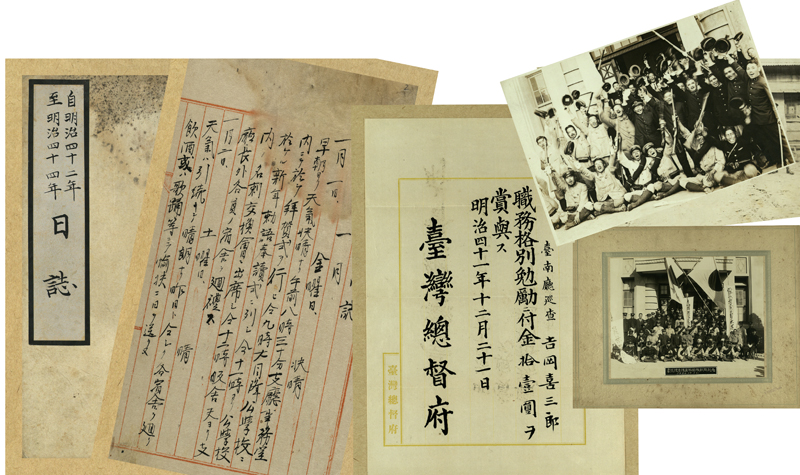
Kisaburo Yoshioka's paper and 12 more collections of 348 items and 28,697 digital images are now available at Taiwan Archival Information System. Kisaburo Yoshioka's paper has tremendous research values and is one of the most significant acquisitions of the Institute of Taiwan History from overseas. Kisaburo Yoshioka (1882-196?), who was born in Chiba Prefecture, Japan, passed the examination for police recruitment in 1907 and departed for Taiwan to take training courses in criminal law, opium matters, household registration, sanitation, epidemic prevention, native language, and martial art. He thereafter began as a frontline police officer, a career that lasted for 24 years during which he worked in Tainan, Taoyuan, Taichung, and Taidong. Yoshioka not only participated in many punitive expeditions against the indigenous tribes but also served as a member of editorial board for Jingcha Yangezhi (History of Police Development). His memoir is published by a descendent and the representative of the Yoshioka family, who conjectures in the afterword that Kisaburo Yoshioka passed away in the 1960s. Materials left by Kisaburo Yoshioka between 1907 and 1939 comprise diaries, work-related documents, resumes and photos, totaling 142 volumes and 4,688 pages. Devoted to preserve valuable sources about Taiwan, discoverers of Kisaburo Yoshioka's paper tried to persuade the Yoshioka's family members who hold the papers to leave them to Taiwan. After a year of constant efforts, Yoshioka's family members finally agreed to donate their unique holdings to the Institute of Taiwan History. These materials reveal the Japanese police's policies pertaining the indigenous, censoring, and economic affairs. Welcome to utilize them for research. Along with Kisaburo Yoshioka's paper, 12 more collections are newly added into the Taiwan Archival Information System, including Zhanghua Zhongshan Primary School Archives, Manuscripts of the Ding Family at Lugang, Graduation Yearbooks of Taiwan Medical and Business Education Schools in Japanese Period, Xiao Xiuying's Paper, Dongshi Village Wu Tianlai's Account Books, Taichung Baojia Records,Account Books of Li Jieji and Li Chunsheng's Store, Account Books of Maochun Yuanji and Zhuyunan, 1940 Account Books of Zhanghua's Gentries , Account Books of Lianmei Store, Account Books from Tongzhi period to the Republican Era (1871-1949), and Shi Chunming's Collection of Private Personal and Family Papers. These distinctive resources feature educational and commercial relevant domains as well as personal and family archives. |