*
Homepage


01/12 (Mon)

Opening Hours 9:00-17:00

*
Visiting the Dadaocheng Customers of Tai-yi-hou in Nagasaki through Time Traveling

Publication date: 2013
Author: Chen Qiu-jin |Staff member of the Archives of Institute of Taiwan History

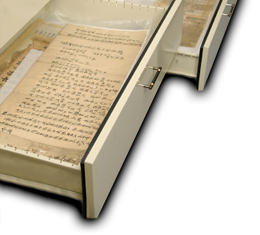
The Chinese enterprise Tai-yi-hou in Nagasaki, one of the figures in Traveling in Time Exhibition, was established in the beginning of the 20th century. Its commercial trade network crossed East-Asia including the treaty ports in Vladivostok, Korean Peninsula, coastline of China, Taiwan, Luzon, Malay Peninsula, etc. Tai-yi-hou’s customers were mainly Chinese merchants in Taiwan and Southeast Asia. Since Taiwan became the colony of Japan in 1895, the Japanese Government proactively increased economic and trade relationships between Japan and Taiwan. Within this context, Tai-yi-hou gained the upper hand in expanding its business to Taiwan with its advantageous location, language and culture. Among all Tai-yi-hou Papers, approximately 17,000 commercial letters sent from Taiwan were preserved until today, and around 10,000 of which were sent from stores in Dadaocheng.
*
Related Collections and References

I. The Archives of Institute of Taiwan History

  1. Map of Damage from the 1935 Hsinchu-Taichung EarthquakeTaiwan Great Earthquake Part 1, Part 3, Photos Related to the Taiwan Earthquake of 1935 Part 1, Part 2, Part 3, Part 4, Commemorative Pictorial of the Taiwan Great Earthquake of 1935, Post-Earthquake Hygiene Guidelines, Yang Zhao-jia Collection (LJK).

  2. 1935 Diary of Huang Wangcheng, Huang Wang-cheng and Huang Ji-tu Papers (T0765).

  3. Historical Photos of June 1935, Collection of documents related to Taiwan by Yuji Mita (T1083).

  4. Clippings from concerts involving Gao Ci-mei, Commemorative Gathering of the Earthquake Charity Concert Tour in Caotun, Program and Admission Tickets for the "Hsinchu-Taichung Earthquake Charity Concert, Commemorative Photo Album of the Charity Concert, Gao Ci-mei Papers (3GCM).

  5. Taiwan Transport Route Map, Da'an River, View from the Third Tunnel to the Fourth through Seventh Tunnels, Michael H. Finnegan Collection (T0203).

  6. Taiwan Shinminpo No. 2673 (1938-07-14) and No. 2674 (1938-07-15), Records of The Taiwan Shinminpo (T1119).

  7. Personal and Family Photos, Miyoshi Tokusaburo Papers (T0875).

II. Taiwan Diary Knowledge Bank

  1. Diary of Lin Hsien-tang, 1935.

  2. Diary of Chang Li-jun, 1935.

  3. Memoir of Miyoshi Tokusaburo, 1938.

III. References

  1. Government-General of Taiwan, Taiwan Earthquake Record of 1935, Taipei: Government-General of Taiwan, 1936.

  2. Taichung Earthquake Recovery Office, The Taiwan Railway Earthquake Record of 1935, Taichung: Taichung Earthquake Recovery Office, 1939.

  3. Sen Hsuan-hsiung, Wu Jui-Yun, The Great Taiwan Earthquake - Documentary of the 1935 Central Taiwan Earthquake, Taipei: Yuan-Liou, 1996.

  4. Chen Yi-Hung, Communities on the Earthquake Belt - Taiwan-Japan Earthquakes in History, Tainan: National Museum of Taiwan History, 2017.

  5. Li Yu-lan, “Descriptions of Earthquakes in Diaries - A Case Study of the 1935 Hsinchu-Taichung Earthquake”, Feng Chia Journal of Humanities and Social Sciences 44 (June 2022): 83-122.


11F., South Wing, Building for Humanities and Social Sciences, 128, Sec. 2, Academia Rd., Nangang Dist., Taipei City 11529,
Taiwan Tel: +886-2-2652-5181 Fax: +886-2-2652-5184 【Contact us
Copyright © 2010 Institute of Taiwan History, Academia Sinica. All Rights Reserved